

MANILA – For Filipino families with loved ones working in the Middle East, the past few weeks have been nerve-wracking. But the government says it's now assisted more than 4,600 overseas Filipino workers affected by the escalating regional tensions, with hundreds more on their way home.
Migrant Workers Secretary Hans Leo Cacdac told a House hearing on Wednesday that the assistance figure—4,608 as of Tuesday—doesn't necessarily mean that many individual workers each received one form of help. Some got multiple services, from temporary shelter to food packs to repatriation flights.
"Thus far, 4,600 ang natulungan natin. It could be the case na yung 4,600 na yan ay one or two or three modes of assistance ang naibigay natin," Cacdac explained. "Maaring nadala natin to temporary accommodation, maaring na-repatriate natin, maaring nabigyan ng pagkain."
The aid hasn't been limited to conflict zones either. Government teams have been assisting workers at transit hubs across Hong Kong, Singapore, Malaysia, the United Kingdom, and Ethiopia.
Coming home, but it's complicated
Right now, 380 OFWs have formally asked to be brought home. But getting them out isn't as simple as booking a flight.
Airspace closures across Kuwait, Bahrain, Qatar, the UAE, and Israel have grounded most commercial flights. Four of those five countries—except the UAE—have no regular flights operating at the moment.
So the government is getting creative. Teams are now pre-positioned at land border crossings, with personnel on both sides ready to escort workers through.
"All the border crossings are identified per each of the five countries, and we have teams that will bring them to the border and teams that will receive them on the other side," Cacdac said. "Naka-pre-position na po yung ating teams that surround these countries."
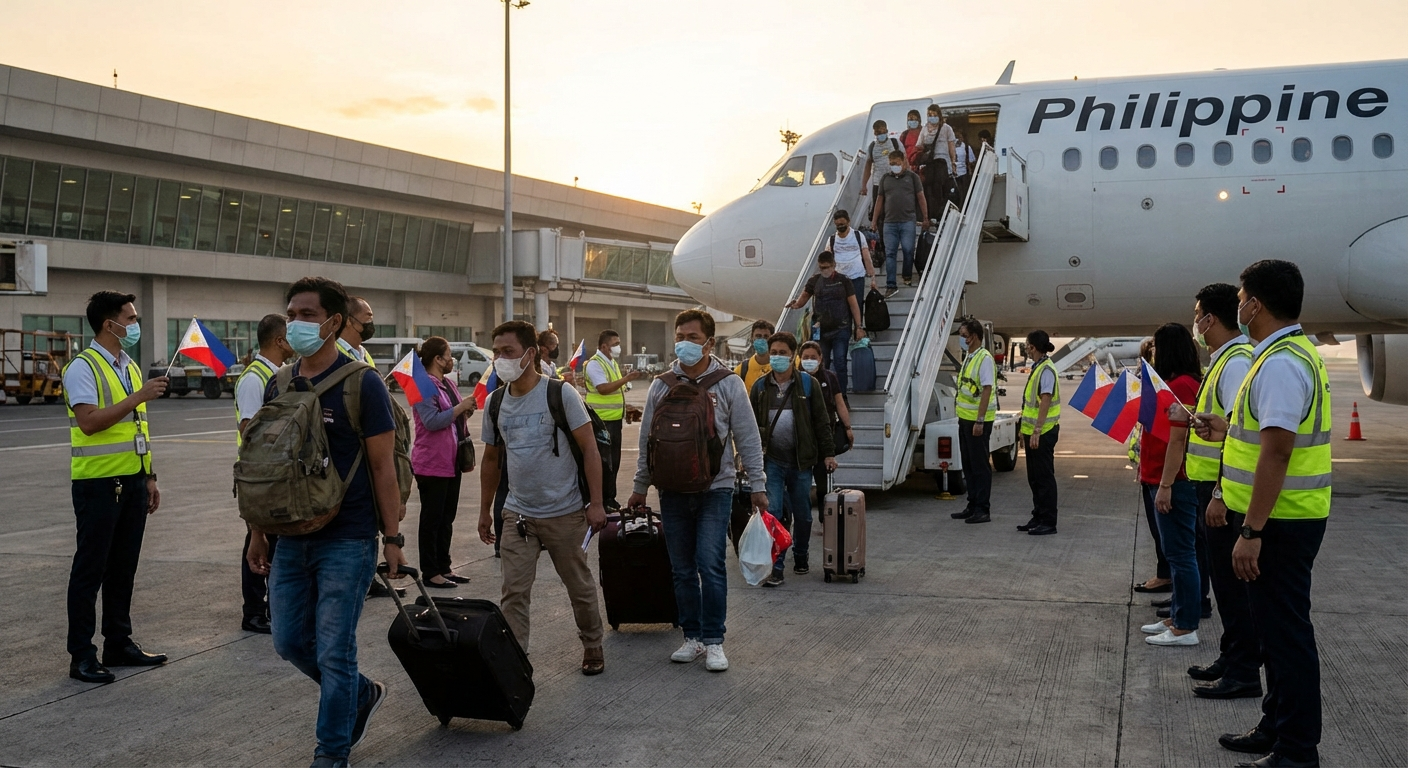
President Marcos Jr. has authorized two chartered flights to help with the repatriation effort. The second batch of repatriates—coming from Riyadh—is scheduled to land at NAIA on Sunday, March 15, at 6:35 a.m. aboard Philippine Airlines flight PR8502. They'll be met by personnel from DMW, OWWA, and the Department of Social Welfare and Development, who can offer psychosocial help, livelihood assistance, or other support depending on what returnees need.
The first group, from Dubai, arrived back on March 5.
According to OWWA, 341 distressed and stranded OFWs from Saudi Arabia, Kuwait, and Bahrain are set to return on a special chartered flight leaving Riyadh on Saturday. Those from Bahrain are being helped to cross land borders safely to reach the staging area in Riyadh.
Money and misinformation
The Emergency Repatriation Fund under the national budget sits at P1.2 billion, and nearly 20 percent has already been used as operations continue.
But OWWA Regional Director Virsie Tamayao had to clear something up: no, OWWA Administrator Patricia Yvonne Caunan is not handing out P150,000 in cash to every arriving OFW. That claim circulating on social media? Not true.
What is true: both documented and undocumented OFWs qualify for the same assistance, including access to government livelihood programs down the line.
The bigger picture
The conflict—missile strikes by the US and Israel targeting Iranian military facilities since early February—has put roughly 2.4 million Filipinos living and working across the Middle East in a tough spot. The largest concentrations are in the UAE (973,000), Saudi Arabia (813,000), Qatar (250,000), and Kuwait (211,000). About 31,000 are in Israel and 800 in Iran.
Most OFWs aren't rushing to leave. DMW Regional Director Rogelio Benitez Jr. noted that of the 453,759 OFWs from the Cagayan Valley region alone, only about 2,000 have requested repatriation—mostly those living near military facilities or critical infrastructure like oil refineries.
But for those who do want out, the government says it's ready. If things escalate further, DMW Undersecretary Bernard Olalia said they're prepared for mass evacuation.
"Handa po tayong ilikas sila kung kinakailangang ilikas at sasalubungin natin at bigyan natin ng reintegration program para manumbalik ang normal kabuhayan po nila," Olalia said.
Not without problems
The operation hasn't been flawless. A video recently went viral showing an employee from the Migrant Workers Office in Bahrain shooing away OFWs seeking financial help outside the Philippine embassy.
"There's nothing, it's that simple. This is not allowed," the employee—identified as Anthony Allermo—told workers in the video, gesturing for them to disperse.
President Marcos wasn't happy. He's ordered an investigation.
"The president was not pleased with this. He became angry on behalf of our OFWs because of the mistreatment by some public servants," presidential palace press officer Claire Castro said.
The embassy had paused financial aid distributions to comply with a Bahraini government ban on public gatherings amid the tensions.
What families should know
For those with loved ones in the Middle East—or workers themselves trying to figure out next steps—the 1348 hotline is operational 24/7. OWWA has added extra personnel and set up WhatsApp numbers, which are widely used in the region, to make sure workers can actually get through.
Country-specific contact details are regularly posted on official embassy and agency social media pages.
The DMW is also working with the Department of Foreign Affairs to cover Filipinos in areas without Migrant Workers Offices, including those who were in the region as tourists when the fighting escalated.
A Senate hearing last week heard projections that the conflict could continue for another four to eight weeks. For the thousands of OFWs waiting to come home—and the families waiting for them—that's a long time.
Topics:
