


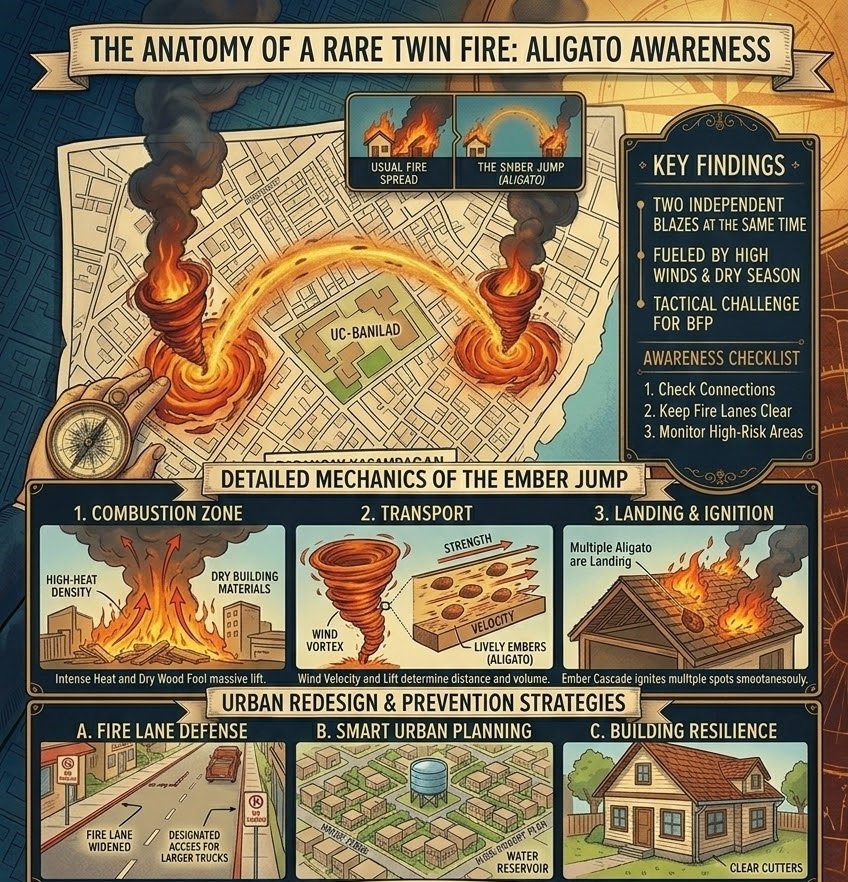
While most reports focus on the heartbreaking loss of homes, fire investigators are currently dissecting the rare "twin fire" phenomenon that overwhelmed responders yesterday. As the first alarm rang out behind the University of Cebu-Banilad, a second, independent blaze suddenly erupted near a gasoline station in the same sitio—not by direct contact, but through airborne embers carried by high winds. This "leapfrog" effect created a tactical nightmare for the Bureau of Fire Protection (BFP), forcing them to split their resources and declare a fourth alarm as they fought a two-front war to protect the university campus and highly flammable fuel reserves nearby.
The survival of the University of Cebu-Banilad and the nearby fuel station wasn't just luck; it was the result of a desperate "line in the sand" drawn by 12 fire trucks and auxiliary units from across Metro Cebu. By successfully containing the 2,600-square-meter inferno within an hour, responders prevented what could have been a multi-billion peso infrastructure disaster for the city’s educational and commercial hub. As we move further into Fire Prevention Month, this incident serves as a technical warning: in the heat of a Cebuano summer, your neighbor’s fire can become your own in seconds, literally falling from the sky through the wind-blown aligato (embers).
The containment of this "twin fire" has reignited a critical conversation among Cebu’s urban planners regarding the vulnerability of "pocket communities" nestled between major commercial developments. As investigators conclude their walk-through of the 2,600-square-meter scorched earth, the focus is shifting toward the "fire-path" risk—how modern, high-rise ventilation and urban wind tunnels may have inadvertently fueled the embers' flight. This incident serves as a loud wake-up call for the city to move beyond traditional fire drills and toward a more integrated emergency response system that accounts for the unique wind dynamics of a rapidly developing Metro Cebu. Protecting our city's future requires more than just water and courage; it demands a strategic redesign of how our residential and commercial zones coexist in the face of an increasingly unpredictable climate.
Topics: